Nils Pisarsky is a designer and creative technologist. He works at the intersection of visual communication, strategy and technology, exploring the potentials of digital thinking for conveying messages and new aesthetics within branding, arts and education.
Nils Pisarsky entwickelt als Designer und Creative Technologist digitale Lösungen für Auftraggeber aus Wirtschaft und Kultur. Dabei vermittelt er zwischen Kommunikation, Strategie und Technologie und untersucht die Potenziale von Programmierung und künstlicher Intelligenz.
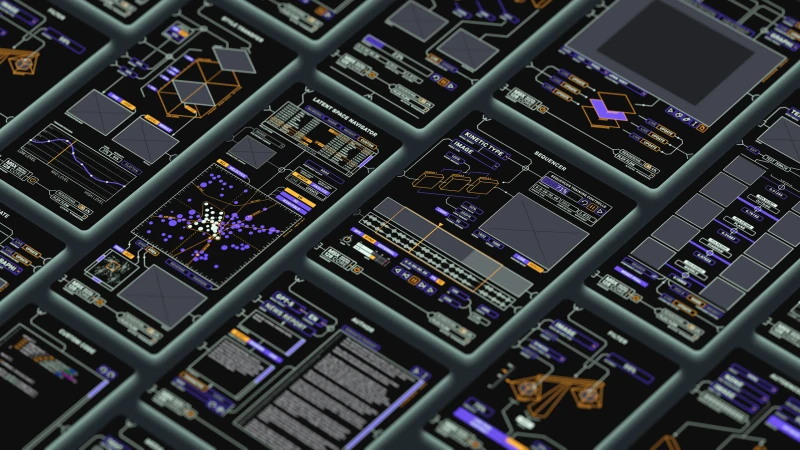
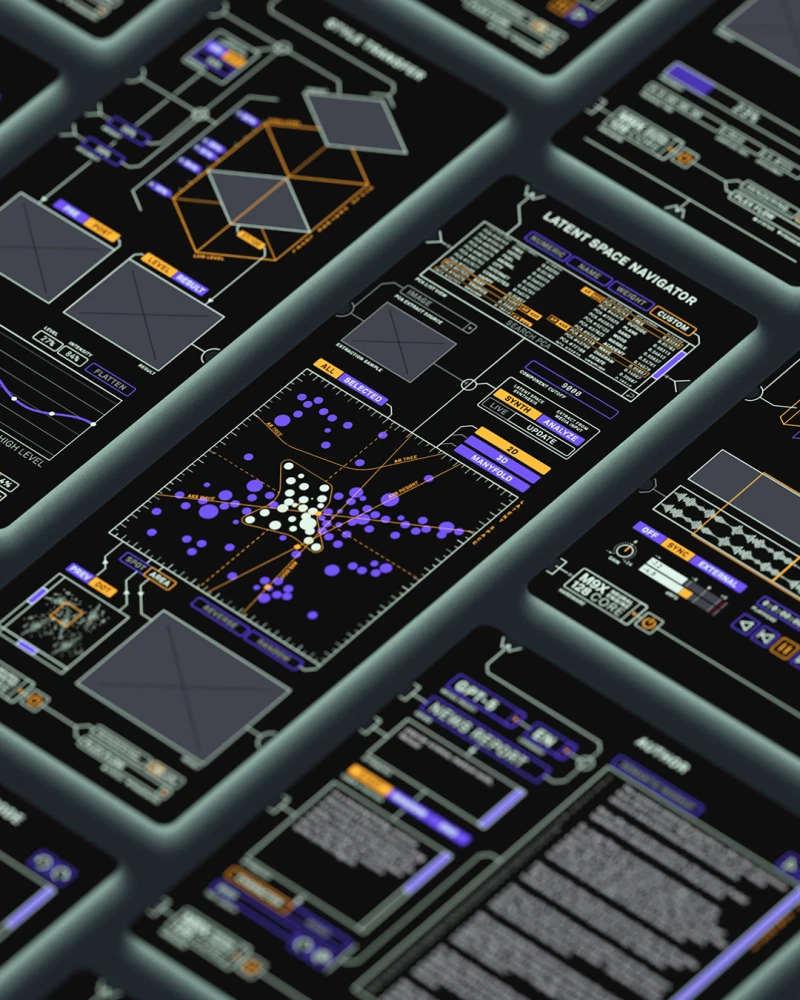
I went back into my 2021 master thesis this week to see how it held up. The timelapse shows a few hundred research slides – state-of-the-art examples, sketches, system diagrams I made to explain neural networks to fellow design students. From 2026 it all reads as ancient. ChatGPT didn't exist yet. GPT-2 was the marvel; image synthesis was 512px squares of beautifully broken slop. That a model could derive information from raw language probability felt astounding.
My thesis tried to imagine – not predict, in the speculative design sense after Dunne and Raby – what an AI-native design tool might look like. The proposal was (link: https://nilspisarsky.de/work/#post-cocreate text: CoCreate): a node-based environment where designers wire together AI modules, latent-space controls, and curated datasets, with an open standard underneath and a marketplace around it.
Some of that landed surprisingly close. Granular semantic control over generation became prompting. Multimodal models made text the connective tissue between media, as anticipated. Style and content separated into manipulable axes through LoRAs and reference images. The node-based interface I had argued for – borrowing the metaphor from TouchDesigner and vvvv, both familiar to semi-technical designers – turned up in ComfyUI over a year later. What I find most striking is the convergence: I arrived there from a designer's view of generative workflows; comfyanonymous arrived there from an ML engineer wanting a better Stable Diffusion UI. Same answer from opposite ends.
What I got wrong was the politics around the architecture. I bet that designers and studios would train their own small models on curated, licensed datasets, with data curation as the new creative labor. The economics didn't cooperate. Prompting got too good too fast, foundation models stayed centralized, scraping happened at industrial scale. In a quadrant diagram I drew at the time, I had mapped a desirable future – specific, data-sparse, local, transparent – against its opposite: generic, data-hungry, centralized, opaque. The opposite quadrant won. The technical predictions held up better than the normative ones – a pattern that probably says something general about speculative work.
The part I didn't see coming is more personal. As image and video models approached competence, my interest in them drained. I think the honest reason is that prompt-based image creation infantilizes a craft I like precisely for its complexity – layout, typography, photography, motion design, all the techniques that demand mastery and reward control. Nothing is implied; every decision is made. A chat box flattens that. So I drifted back to where I started: building tools. Generative systems, algorithmic design, digital products, AI-assisted coding. The interesting frontier, for me, turned out to be on the other side of the interface.
Pattern-based design systems are ideal for larger projects as they seamlessly adapt to different media and requirements. To give our design team maximum creative control and speed up pattern creation for various aspect ratios and sizes, I developed a web-based tool for setup, randomization, and fine-tuning. File export enables easy handoff to other software. Custom tools like this dramatically accelerate workflows, are intuitive even for non-designers, and help maintain design consistency across larger teams.
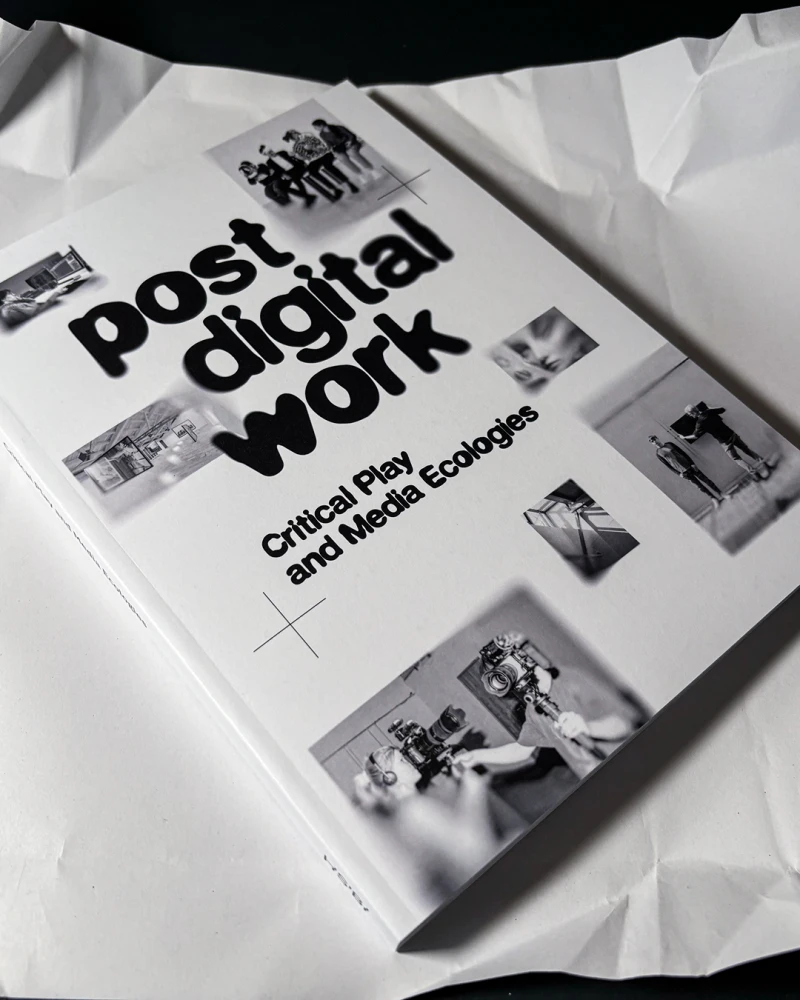
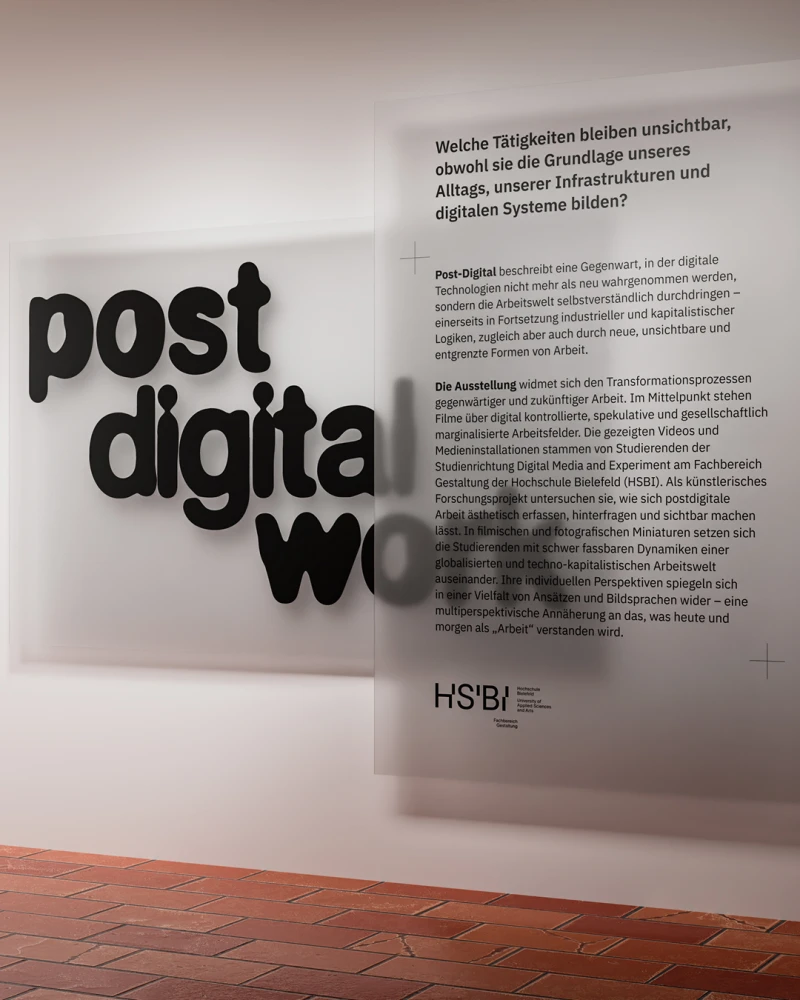
To promote and document an artistic research project exploring invisible forms of labor in our digital age, I had the pleasure of leading a team of HSBI students in creating a comprehensive design system and multimedia publication.
The exhibition "Post Digital Work," developed within the Digital Media and Experiment program at HSBI's Faculty of Design and Art, presents video works by interdisciplinary students examining how digital technologies have become inseparable from contemporary work life and what new forms of labor are emerging from them.
The resulting publication includes a website and a 160-page book featuring all works, process documentation, and critical essays. Our design concept, "Shifting Focus," uses blur aesthetics to mirror the exhibition's theme of illuminating often-overlooked aspects of contemporary work realities.
Every graphic designer loves Illustrator's Blend Tool, which allows you to interpolate between multiple shapes. For a client project, I wanted to adapt this principle but with support for dynamic changes and motion. The resulting script uses noise displacement to distort typography in real time.
Simple yet hypnotic. For a coding challenge, I developed this generative animation setup that creates cubic Bézier grids with oscillating proportions and color gradients. The aesthetic draws inspiration from Green Wall Designs' stage visuals for the Eurovision Song Contest 2024 and Studio Dumbar's visual identity for Ruhrtriennale 2024. This principle is both straightforward to implement and adapt to different applications, while generating visual entropy that makes for an appealing effect.
ContactKontakt
You want to know more? For business inquiries or collaborations please get in touch.
Anfragen oder Projektideen? Jetzt Kontakt aufnehmen.